
 |
|
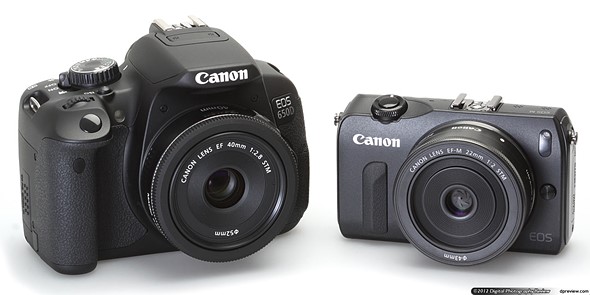
The original EOS-M was significantly smaller than the DSLRs Canon was selling back at its launch in 2012. Photo: Andy Westlake |
Well, the writing has been on the wall for a while, but Canon’s Japanese website has finally confirmed the end of the EF-M system. Or, at least, is describing all the EOS-M camera models as being discontinued.
Recent Videos
Canon USA told PetaPixel, “At present, sales of EOS M series cameras and EF-M lenses vary from region to region depending on user needs,” but the confirmation that sales have stopped in Canon’s home market, where the EOS-M models sold particularly well, tells a fairly clear story.
The EF-M system, Canon’s first foray into mirrorless cameras, was a compact APS-C mirrorless system that could use EF and EF-S DSLR lenses via adapter, but its own lenses could only be used on EF-M bodies.
The range extended from some of Canon’s smallest, most affordable beginner-friendly ILCs up to the enthusiast-focused M5 and M6 models. The relatively small lens range reflected this focus, with a handful of variable aperture zooms supplemented by three relatively compact primes.
 |
|
Canon has made an RF-S version of the EF-M 18-150mm F3.5-6.3 IS STM but there are no RF-mount equivalents of the EF-M 22mm F2, 32mm F1.4 or 28mm F3.5 Macro, let alone Sigma’s 16, 30 and 56mm F1.4 DC DN trio. Photo: Carey Rose |
But beyond Canon’s own efforts, Sigma offered a trio of DC DN autofocus primes and there was a selection of manual focus primes from other third-party manufacturers, which could be used to create some powerful, compact kits.
However, the inability to use EF-M lenses on other bodies is likely to have discouraged large-scale investment in the system by enthusiasts. The belief in full-frame as an inevitable end-point (heavily promoted by the manufacturers) prompts some enthusiast photographers to focus on the full-frame camera they might buy, rather than the APS-C camera they actually have, which can dent the appeal of a system without the promise of such an ‘upgrade path.’
 |
|
The arrival of models such as the EOS R50 and EOS R100 (which shares its sensor and processor with the EOS M50 II) spelled the end for the EOS-M line, even if the new cameras give up some of the EF-M system’s compactness. Photo: Richard Butler |
The arrival of the RF mount undermined confidence in the future of the system and the launch of APS-C RF models essentially spelled the end for EF-M. The R cameras sacrifice some of the compactness of EOS-M modes and currently have fewer APS-C (and APS-C appropriate) lens options, but give buyers the confidence that Canon is committed to the lens system. To some degree, anyway: Canon doesn’t have a great history of fleshing out its APS-C systems, perhaps in the hope of up-selling people to its full-frame cameras and, unlike with EF-M, has been actively blocking third parties from doing so.
But, regardless of where we stand or how we got here, it seems that, after eleven years, Canon has turned a page on the first chapter of its mirrorless camera story.

Our DPREVIEW Tribute:
After nearly 25 years of operation, DPReview closed on 10 April 2023. This difficult decision was part of the annual operating plan review that parent company, Amazon, shared earlier this year.
Over the course of 25 years, DP Review built up a reputation as being one of the most informative places to go for information about that new camera or lens you’re after. DP Review began as an independent reviews site based in the UK in 1998, the brainchild of Philip and Joanna Askey, but it was eventually purchased by Amazon in 2007 and relocated over to Seattle in the USA in 2010.
Cheers DPReview – thanks for the great work and content that guided photographers, videographers and techno junkies the world over!