Brain-altering fungi could lead the next frontier in mental health care – here’s how:
If you were one of the millions of people who watched HBO’s TV series The Last of Us, you probably have a heightened awareness of the threat that fungi can have to our health.
The series is set in a post-apocalyptic world where parasitic fungi take control of the human brain, turning people into killer zombies. The scariest part of this premise is that it’s not entirely implausible. Parasitic or “zombie” fungi that alter the mind and behaviour of their hosts do exist.
Fortunately, real-life zombie fungi (known as Cordyceps) only infect insects. The fungus hijacks their bodies for the sole purpose of spreading its seed-like fungal spores. When spores are ingested by insects, they germinate and grow, secreting molecules that travel to the host’s brain and interfere with its function.
The fungus compels the insect to forego its aversion to heights and climb upwards. Upon reaching a position optimal for fungal survival, the fungus induces the “death grip” and then devours its host from the inside-out, sprouting spore-containing mushrooms from the insect carcass.
Fungi that alter our minds
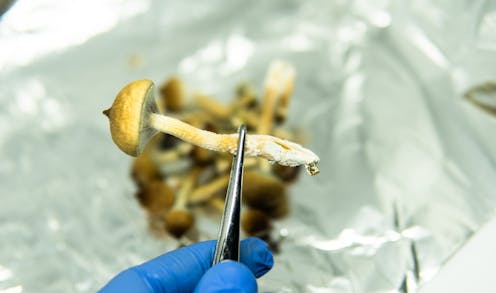
In the case of humans, some fungi which produce small molecules, or metabolites, that alter our minds – and recent research shows these have therapeutic potential. The most widely known is the hallucinogen psilocybin – the active ingredient in magic mushrooms. LSD, or lysergic acid diethylamide, is another psychedelic with fungal origins.
Humans have known about the hallucinogenic properties of fungi for centuries. The Aztecs even gave magic mushrooms to people who were dying to promote a peaceful transition to the afterlife.
But recently, there’s been an explosion of interest in fungal metabolites, specifically because of their neurological benefits and potential in treating mental health conditions. And it’s no wonder, given the mechanisms fungal metabolites use to interact with our nervous system.
Think of our brain like a map. When we’re young, we explore all corners of this map, sending out connections in every direction to make sense of our environment. Before long, we figure out basic truths – such as how to secure food, or where we live – and the neurological paths that make up these connections strengthen.
Over time, a network emerges that reflects our unique experiences. Regions we re-visit often will develop established paths, whereas under-used connections will fade away.
Conditions such as addiction, chronic depression and post-traumatic stress disorder (PTSD) are characterised by processes such as repetitive negative thinking or rumination, where patients focus on negative thoughts in a counterproductive way. Unfortunately, these strengthen brain connections that perpetuate the unfavourable mental state.
But it’s believed that fungal metabolites give our brain the freedom to explore less-visited territories again. Psychedelic “trips” are thought to allow people to experience a world without the boundaries of reality – and more recent research suggests this is a manifestation of novel brain exploration.
For example, psilocybin stimulates a receptor in the brain called 5-HT2a. This receptor usually binds to serotonin, a chemical in our body which controls communication between specific nerve cells. But when psilocybin binds to the 5-HT2a receptor, it makes it easier for our brain to change and generate new connections (including causing hallucinations at high doses). We call this an increase in neuroplasticity.
Although the effects of a single large dose of psychedelics are transitory, evidence shows administering two smaller doses of psilocybin three weeks apart leads to a sustained increase in connectivity between different functional regions of the brain. Such changes in neuroplasticity have the potential to disrupt the rigid thought patterns that underlie certain mental health conditions.

Furthermore, by increasing neuroplasticity, it is believed that psychedelics allow people to view life situations from a new perspective. Combining psychedelics with more traditional talking therapy could make it possible to explore – and more fully understand – the initial trigger for negative thought patterns. This could potentially prevent the same negative cycle reestablishing after treatment. Indeed, research showed that combining therapy with psilocybin had a prolonged anti-depressive effect in adults with major depressive disorder.
Additional studies demonstrate the positive effect of fungal metabolites in treating a range of conditions – including anxiety, depression and alcohol addiction. These studies also point out that psilocybin can affect the symptoms after only one or two doses – whereas anti-depressants may take many months to work.
No miracle cure
That said, psychedelics should not be considered a miracle cure as there is still a lot we don’t know. Furthermore, most studies on psychedelics are still preliminary as they use a limited number of participants. As such, experts are divided on the efficacy of psychedelic treatment. Furthermore, psychedelics are powerful and unpredictable – and the safety and long-term effects of such treatment is unknown.
But given the current mental health crisis, any intervention that offers a new approach to tackling these conditions – especially those that are treatment-resistant – needs to be carefully considered and rigorously researched.
Excitingly, many countries recognise the benefits of psychedlics for mental health treatment. The Australian government even legalised prescription psilocybin for medicinal use in 2022. Although the UK doesn’t yet permit the prescription of psychedelics, multiple research centres are undertaking trials to establish the mental health benefits of fungal metabolites.
While there’s still much we don’t know about fungal metabolites – including whether other molecules exist that have a similar effect on neurological function – it’s clear they have great potential in mental health treatment. Perhaps it’s time for us to relinquish certain negative connotations we have of illicit fungal drugs, and become comfortable thinking of brain-altering psychedelics as medicine.

Edel Hyland does not work for, consult, own shares in or receive funding from any company or organisation that would benefit from this article, and has disclosed no relevant affiliations beyond their academic appointment.
: The Conversation – Articles (UK)
Have you tried: Farking?