
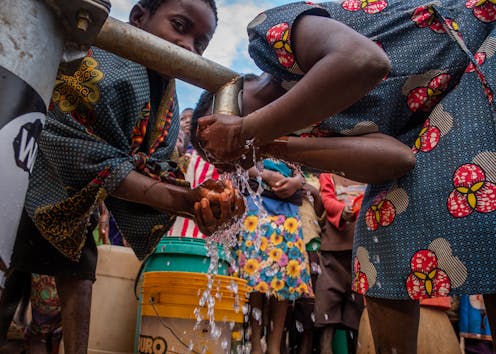
More than 2 billion people around the world do not have access to safe, uncontaminated drinking water. Around 418 million of them live in African countries.
The problem is most acute in rural communities, where people’s primary water sources are rivers, lakes and hand-dug wells, which are often contaminated with harmful pathogens. This contamination is caused by inadequate sanitation facilities, open defecation practices, and agricultural runoff, and it has dire consequences.
Waterborne diseases such as cholera, typhoid and diarrhoea claim hundreds of thousands of African lives each year. Children are especially vulnerable to these diseases because of their developing immune systems. And the cycle of waterborne diseases not only affects health: it also perpetuates poverty, as sick children are unable to attend school and adults are unable to work, hindering economic progress.
Read more: Cholera: vaccines can stop the spread, but the biggest deterrent is clean water
The existing solutions for water treatment often fall short. Conventional methods, such as boiling or chlorination, can be time-consuming, require fuel or chemicals, and may alter the taste of water, making people less likely to take precautions.
Filtration systems, while proven to be effective, can be expensive and require regular maintenance. This makes them inaccessible to many rural communities.
The need for a simple, affordable and sustainable solution is clear. What if part of that solution is lying in your kitchen drawer right now, in the form of a roll of aluminium foil?
I am an environmental engineer. With my colleagues I have developed a foil coated with a special material called layered double hydroxide (LDH). This material acts like a magnet, attracting and trapping microbes. In laboratory tests we found the LDH foil remarkably efficient, removing over 99% of E. coli bacteria, a common indicator of water contamination, from water samples within a few hours. We found that its efficacy also extends beyond E. coli, targeting a wide range of waterborne pathogens, including bacteria, viruses and parasites. This means that the LDH foil offers comprehensive protection against various diseases.
Our invention is not intended to be a standalone solution, and of course further testing will be needed, especially in the field. However, we believe it can become a valuable addition to existing water treatment practices. It can be used along with traditional methods like boiling or filtering, providing an additional layer of protection and ensuring comprehensive water safety.
How it works
This isn’t a completely new idea; it was already known that layered double hydroxide could trap contaminants. Our innovation was making it into a simple, easy-to-use foil.
The LDH foil’s magic lies in its ability to adsorb or capture harmful pathogens from water. Imagine a sponge soaking up water – that’s absorption, where one substance is taken into another. Adsorption, on the other hand, is like sticking magnets to a fridge; substances cling to the surface of another material.
The science behind this process is fascinating. The LDH surface is positively charged, while most microbes have a negative charge on their surface. This creates an electrostatic attraction, drawing the microbes towards the LDH foil like iron filings to a magnet. Other chemical and physical forces contribute to making pathogens bind to the LDH surface, ensuring their effective removal from the water.
We tested the LDH foil in a lab by adding bacteria to clean water and then dipping the foil in to see how many bacteria it could remove. It turns out the foil was really good at its job – it removed more than 99% of the bacteria within 3 to 24 hours, depending on the specific type of LDH foil used, as different formulations exhibited slightly varying adsorption rates.
Advantages tailored for Africa
There are several reasons we believe that LDH foil is ideal for use in African countries.
The first is that it’s simple and affordable. The production process is remarkably straightforward and inexpensive. We estimated the cost of producing LDH foil for one year’s use is approximately US$ 6.93 per person. This makes it suitable for local production even in remote areas with limited resources. It not only ensures accessibility but also empowers communities to take ownership of their water safety, fostering self-sufficiency and reducing reliance on external aid.
Secondly, it’s easy to use. That’s a key advantage in contexts where technical expertise and complex instructions might be barriers to adoption. Its simple design and operation make it accessible to everyone, regardless of their education level or background.
It is also reusable, which is important in resource-constrained environments. After use, the foil can be regenerated multiple times by being re-immersed in simple alkaline solutions like sodium carbonate solution, commonly known as washing soda or soda ash, which is a readily available and inexpensive alkaline salt. This promotes sustainability and reduces the environmental impact associated with disposable water treatment solutions.
Read more: From waste to clean water: tiny carbon particles can do the job
We’ve also taken cultural sensitivity and adaptability into account. The LDH foil’s design and implementation can be adapted to fit the cultural context and specific needs of different African communities.
One practical example of this is the use of seawater as the alkaline solution in its production, particularly for coastal communities with easy access to this resource. This is primarily a matter of geography and what resources are available – but it also ties into cultural adaptability. Coastal communities often have a strong connection to the sea and its resources. Similarly, using fertilisers as a magnesium source (magnesium is a key component of the LDH foil’s production) will resonate with agricultural communities where these materials are commonplace and familiar.
The road ahead: a collaborative journey
While the LDH foil holds immense promise, its widespread adoption will require a collaborative effort.
Further research and development are needed to optimise its performance, address any potential limitations, and ensure its long-term effectiveness in diverse African environments. We published our study in open access format using a Creative Commons licence (CC BY 4.0) to ensure that all our data is publicly available and that others are able to test the LDH foil in specific settings, replicate our findings, and build upon our existing research.
Field trials in various communities will be crucial to gather user feedback, assess its practicality, and identify any cultural or logistical considerations. Moreover, partnerships with local organisations, governments and NGOs will be essential for production, distribution and education on its proper use. The journey towards clean water for all is a shared responsibility. We believe that LDH foil represents a powerful tool in this endeavour.

Taufiq Ihsan does not work for, consult, own shares in or receive funding from any company or organisation that would benefit from this article, and has disclosed no relevant affiliations beyond their academic appointment.
: The Conversation – Articles (AFRICA)
Have you tried: Sailing in Africa ?