
After lockdown: what you can expect when you go to the dentist:

Since COVID-19 was declared a global pandemic in March 2020, it has caused unprecedented disruption to our everyday lives, not least to our health services. While hospitals braced themselves for an influx of COVID-19 patients, other areas of healthcare were severely affected. Suddenly, for example, going to the dentist was no longer an option.
Dental practices in the UK and across the world were forced to stop all non-emergency face-to-face dentistry to reduce the potential risk of virus transmission. Now, as governments worldwide begin to ease restrictions, the dental profession is planning a safe return for the delivery of care. But the care you receive and the dental practice you visit is likely to be different to what you were used to before COVID-19.
To explore the changes implemented in dental practices internationally, a group of researchers and clinicians from a range of UK institutions, led by Craig Ramsay at the University of Aberdeen and Jan Clarkson at the University of Manchester, conducted a rapid review of the international dental guidance. The group’s overall aim was to produce a document that would facilitate decision-making and support policy planners in producing their own national guidance for the resumption of dental care services.
This review offers a summary of 17 guidance documents from 16 countries such as the US, Canada, Australia, New Zealand, India and several European countries that reported on the re-structuring and re-opening of dental services.
Why dental practices are different
There have been numerous changes introduced to dental practices re-opening following easing of the COVID-19 lockdown. This is due to a suggested potential risk of virus transmission from aerosol-generating procedures (AGPs) – common procedures you may have at the dentist, such as ultrasonic scaling or the use of the dental drill for treatments such as fillings.
The aerosol generated from these procedures can suspend in the air and travel up to 1.5m from the source. It is therefore essential only patients who show no signs or symptoms of COVID-19 attend their dentist.
Another big consideration in dental practices is the high daily volume of patients seen in a relatively confined physical space. Dentists also work in very close proximity to their patients, both factors which further increase the potential risk of virus transmission. With this in mind, several changes have been introduced to dental practices to ensure the safety of patients and staff.
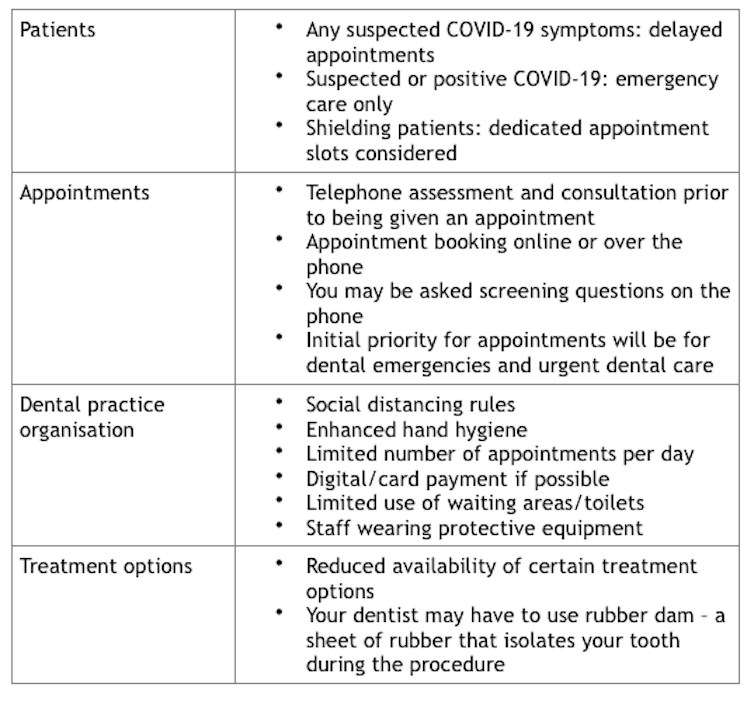
What treatments can I have?
The treatments available will depend on your dentist and location, but the table below illustrates treatments that are more likely to be available and those that are deemed too risky for the moment. Any treatment option should be discussed thoroughly with your dentist.
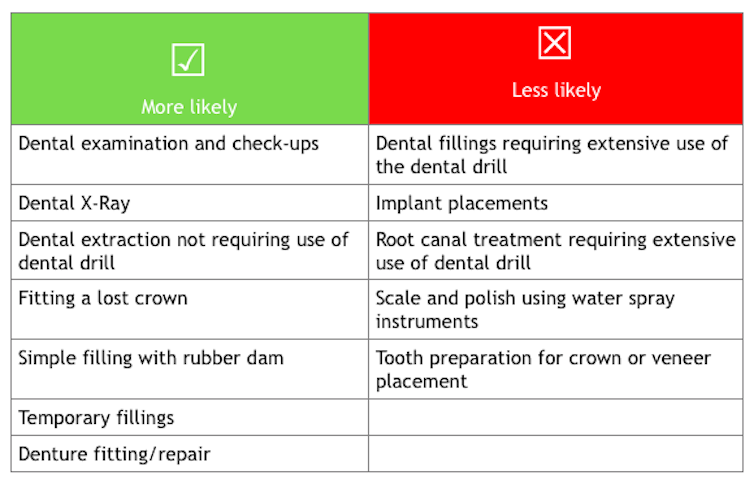
Some dental practices such as those set up as dedicated urgent dental care centres may conduct higher risk procedures such as AGPs, but there will be strict rules for selecting which patients and when such procedures are suitable.
What’s next?
Many countries have now resumed dental services, implementing new guidelines designed to ensure patients are treated safely while meeting their individual dental needs. This rapid review published by Cochrane Oral Health, has been used by all four nations in the UK to produce several guidance documents for dental practices.
Its pragmatic and steady scientific approach will help ensure the gradual and safe resumption of dental services. And of course when further evidence emerges, a return to near “normal” dental care will be once again possible.

Manas Dave receives funding from NIHR, The Pathological Society of Great Britain and Ireland, the British Society of Oral and Maxillofacial Pathology and The University of Manchester. With kind appreciations to Thibault Colloc for his contribution to this article.
Beatriz Goulao and Gavin J Wilson do not work for, consult, own shares in or receive funding from any company or organisation that would benefit from this article, and have disclosed no relevant affiliations beyond their academic appointment.
: The Conversation – Articles (UK)
Have you tried: Sailing in Africa ?