
Africa’s relationship with India: a diplomat’s view:
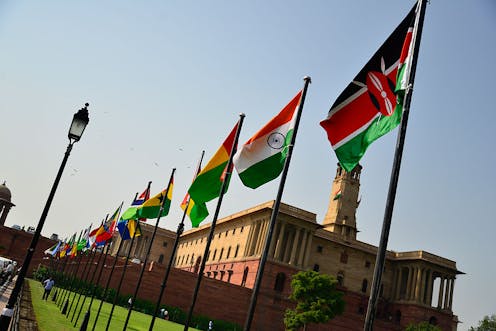
Rajiv Bhatia, who represented India as the most senior diplomat to Kenya, South Africa and Lesotho for a combined seven years, has written an account of the relationship between his country and Africa. It comes at a time when India’s relationship with countries on the continent has been gaining momentum. This is shown by growing trade and investment, an increase in high level political engagement, and New Delhi articulating ten specific principles that guide it’s engagement with Africa. Veda Vaidyanathan, who has researched Indian and Chinese contemporary engagement with various African countries, discusses what the new book adds to the understanding of this growing relationship.
What’s the book about?
India Africa Relations: Changing Horizons looks at the factors that have driven and shaped the relationship between India and Africa. The book explains how it has transformed with time, and recounts Bhatia’s own professional journey.
The author switches between perspectives and dimensions of the relationship – temporal and thematic, geographic and historic, anecdotal and critical.
He begins by providing an “optimistic-realistic evaluation” of the continent’s potential. A youthful demography, fast growing economies and proven resource wealth are grounds for optimism. He also flags issues like regional conflicts, poverty and high unemployment. He says the “world too has a responsibility to assist Africans secure their goals” and this should be based on a “respectful and empathetic attitude”.
Using an array of data sources, he presents a summary of key developments in the Africa-India relationship, first before and after 1947, and later from 2000 to 2019.
The narrative then shifts to Africa’s changing relationships with other countries and blocs. This is to drive home the point that “much of the world is far more interested in Africa today than it was 20 or even 10 years ago”. Their interests are “varied but largely common”, including security, access to natural resources, a growing market and “development of the continent’s human resources”.
What fresh insights does the book offer?
The author’s approach to Africa’s changing geopolitics is crucial on many counts. Scholars have largely studied the engagement of Indian actors in the region in isolation. They assume the levers that shape these relationships are largely internal. Their perspective overlooks a range of factors, particularly the impact of global events on African economies and how powers reengaging Africa are changing the status quo.
Bhatia’s primary aim appears to be underlining Africa’s importance to India’s foreign policy calculations. But the main questions that guide the book are these: how can New Delhi engage countries in Africa as other global actors, especially China, are stepping up their interactions in the region? And how can India-Africa relations be more comprehensive and productive?
What struck you as the most interesting thing about the book?
The author argues that relations “will be influenced by the larger global developments, especially the US-China relations that came under serious stress in the recent years”. Among other influences will be “the direction of the global economy once it begins to recover from the massive damage caused by COVID-19”.
For New Delhi, the most critical external partnership to examine closely would be China’s. Bhatia devotes an entire chapter to this, tracing the timeline and examining various aspects of this multifaceted relationship. They include summit diplomacy, trade, investments, projects under China’s Belt and Road Initiative, and a growing diaspora.
He then presents a prudent assessment:
“instead of demonising China’s Africa policy and its implementation, the competing nations need to focus on analysing it objectively and devising a more attractive policy model for themselves.
He urges other powers to consider that
Africa needs and welcomes a multiplicity of options for partnerships.
Policymakers should consider each nation’s individual strengths and craft sustainable alternatives.
The book does not shy away from addressing difficult issues. Among them are the slow and inadequate implementation of previous agreements and commitments, lack of clarity in India’s Africa policy and attacks against African students in India.
Who should read it and why?
This book is a must-read for those interested in international affairs. But it will also be of interest to a broader audience. The insights are rooted in the reflections of an individual who has had a front row seat as the India-Africa relationship has evolved. Weaving personal impressions with the ideas of leaders like Mahatma Gandhi, Kwame Nkrumah, Jawaharlal Nehru and Nelson Mandela, the author reminds the reader of the social, philosophical and cultural congruities that have guided the relationship.
The book places the responsibility of African growth on its leaders, people, and civil society. But he also recognises the role partners like India can play in achieving its goals. According to the author, this is crucial because the world stands to benefit from the continent’s prosperity as Africa is the future.

Veda Vaidyanathan is a Visiting Associate Fellow at the Institute of Chinese Studies (ICS), New Delhi. She was a recipient of the ICS – Harvard-Yenching Institute (ICS-HYI) Fellowship for China Studies and was also a Doctoral Fellow of the Indian Council of Social Science Research.
: The Conversation – Articles (AFRICA)
Have you tried: Visiting Port Elizabeth?