
Hundreds of billions of emails are sent and received on a daily basis and it has been calculated that more than 97% of business documents are created electronically. In addition, the modern, digital world sees the average person produce thousands of digital records or electronically stored information (ESI) daily, ranging from computer generated content such as emails and their attachments, social media, cell phone data, digital audio or video recordings, and more.
In short, the very nature of what constitutes information and documentary evidence, types and sources, and how they are dealt with, has changed. So, too, has the manner in which litigators must now collect, review, and produce evidence.
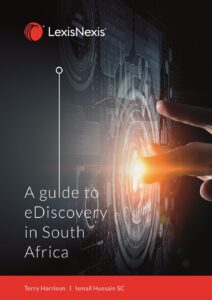
It is against this backdrop that A Guide to eDiscovery in South Africa (ISBN 9780639012629, available from https://bit.ly/3uOQoeY), has been published by LexisNexis South Africa.
Authored by Terry Harrison, who is currently the only independent eDiscovery Consultant in South Africa and wider Africa, together with former Judge of the High Court and Competition Appeal Court, Ismail Hussain SC, the book is the first text on this subject in Africa.
It answers the call for expert guidance on this rapidly developing topic, explaining in understandable language what eDiscovery is, why we need it, how it affects dispute resolution and the risks and dangers of ignoring it.
Harrison says that decided cases elsewhere make it clear that it is not the duty and responsibility of a lawyer to look at every document with human eyes.
“What we do need is modern and technology aware lawyers who look at a case in perhaps a different way than old traditional methods, using Early Case Assessment (ECA) tools and working with an experienced service provider using appropriate technology. All of this will save time and will save money for the client as well as finding favour with the Court,” he advises.
Discovery traditionally is the legal process governing the right to obtain and the obligation to produce evidence relevant to any party’s claims or defences in litigation. Reviewing documents for discovery and ultimately trial, makes up the largest cost in litigation.
With eDiscovery still burdening many legal professionals and requiring close cooperation and understanding between Legal and IT professionals, attorneys and their clients must educate themselves on the applicable rules and their practical implications for ESI and eDiscovery in litigation.
In the practical application of eDiscovery and case management in South Africa – which remains one of the last common-law jurisdictions in the world not to have eDiscovery as part of its rules of Civil Procedure – it is rule 35 of the Uniform Rules that applies along with s 15 of the Electronic Communications and Transactions Act 25 of 2002. However, because eDiscovery is not incorporated, unlike the rest of the modern world, South Africa’s rules are hopelessly out of date.
A Guide to eDiscovery in South Africa examines the rules of civil procedure in other jurisdictions and the current position in South Africa. It also looks at the effect of eDiscovery on Data Protection and Privacy, including cross-border litigation and particularly in the light of POPIA ahead of the anticipated implementation date of 1 July 2021. Also included is a glossary of terms to be used as a permanent reference.
The authors make a compelling case for both the wider adoption by the legal fraternity of eDiscovery, and the need for South Africa to have the practice of eDiscovery incorporated into our rules of civil procedure.
“In terms of South Africa, we cannot have rules and practices which only benefit those clients or large law firms in various centres in the country, in exactly the same as the UK cannot have laws for London but nowhere else in the country, or in USA for New York but nowhere else,” says Harrison.
Need guidance around successful eDiscovery and defensibility within the South African context? Visit the LexisNexis online bookstore at https://bit.ly/3uOQoeY for the new book A Guide to eDiscovery in South Africa by Terry Harrison and Ismail Hussain SC, available in print for R437.00 excluding delivery.
CLICK HERE to submit your press release to MyPR.co.za.
Submit your Press Release for free to MyPR here: MyPR Free Press Release Submission.