
The climate is changing, and heatwaves are becoming more common and intense as a result. For the Great Barrier Reef, the world’s largest structure of living tissue, the consequences are clear. The reef suffered its third mass coral bleaching event in five years in 2020, caused by prolonged periods with high water temperatures. Conservation scientists recently downgraded the ecosystem’s condition to “critical”.
You might expect mobile animals like fish to fare better, but their body temperatures closely match that of the surrounding water. Fish can of course swim and escape high temperatures to an extent – and many species have shifted their ranges poleward or into deeper, cooler waters. But migration isn’t always possible. Freshwater fish, for instance, are restricted to their native rivers or lakes. Their ability to adapt to high temperatures may decide whether or not they endure.
Whether an organism does survive a heatwave may depend on its upper thermal tolerance – the temperature at which the organism can no longer function. Some fish populations are already living in water close to their temperature limits and so only have a small margin of additional warming they can safely tolerate. As heatwaves become more extreme and maximum temperatures increase, those species that cannot evolve fast enough to tolerate them may go extinct.
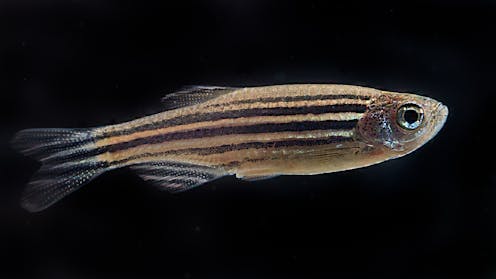
In a recent study, colleagues at the Norwegian University of Science and Technology and I measured the evolution of thermal tolerance using a wild population of zebrafish. Working in a lab, we selectively bred fish which excelled at resisting high temperatures. Over six generations we selected more than 20,000 of these zebrafish in an experiment lasting three years.
Climate change is outpacing evolution
Zebrafish are the lab rats of the aquatic world, but in the wild, they can be found in shallow ponds and streams in South Asia, at temperatures very close to their thermal limits. Shallow water can heat up rapidly during heatwaves, so zebrafish are an ideal species to help us understand whether evolution will keep up with rising temperatures.

After breeding zebrafish with the highest levels of thermal tolerance for six generations, we found that this upper limit increased by 0.04°C with each new generation. It’s encouraging that species can evolve this ability, but the rate of change is likely to be too slow for most fishes. And while evolution helped make this species more tolerant of higher temperatures over time, it hindered how well the fish could acclimate.
Acclimation is how animals exposed to environmental change adjust their physiology to cope better in the new conditions. In our experiment, one group of fish acclimated to raised temperatures over two weeks, allowing their thermal tolerance to increase. Acclimation occurs within individuals, while evolution occurs across generations.
But zebrafish cannot keep raising their thermal tolerance infinitely. We found that fish which had evolved to raise their upper thermal tolerance could only acclimate to a smaller amount of further warming. Eventually, their physiology will probably reach a temperature ceiling which they’re unable to overcome, either by evolving or acclimating, making death likely. Zebrafish in their native habitats in India will struggle to keep increasing their tolerance to match the projected rate of warming.
It’s possible that other tropical species living close to their thermal limits will face a similar situation, and be especially vulnerable to climate change. Temperatures are already exceeding these limits for certain species. Mass deaths following heatwaves have been reported not only for fish, but also in warm-blooded animals such as tropical birds and bats.
Climate change is likely outpacing evolution for many tropical species. Unless we dramatically reduce greenhouse gas emissions, it’s possible that many populations will become extinct over the coming decades.

This work was funded by the Research Council of Norway and the Norwegian University of Science and Technology (NTNU).
: The Conversation – Articles (UK)
Have you tried: Visiting Port Elizabeth?