
A close up look at the social networks of Lake Victoria’s fisherfolk:
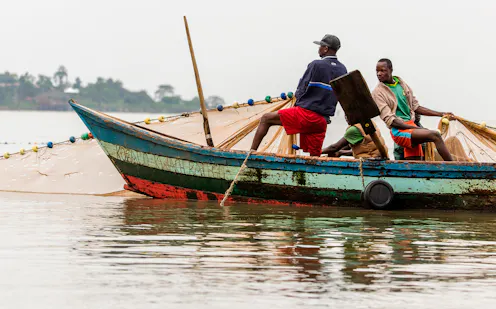
The fisheries of Lake Victoria, the second largest freshwater body in the world, support the livelihoods of around three million people in the countries that border the lake – Kenya, Tanzania and Uganda. But there have been widespread concerns, since the early 2000s, that fish stocks and catches of the key commercial fishery of Nile perch are declining. This is largely attributed to pollution, overfishing and the widespread use of illegal gear that catch undersized fish.
With around 1,500 landing sites, Lake Victoria sustains about 200,000 fishers, referring both to the owners of boats and the crew who undertake the manual work of fishing. There are then the small-scale fish processors (usually women), agents who buy fish for fish processing factories and local traders who buy for local and further markets.
These fisherfolk live and work at the fish landing sites where they develop close social and economic ties over time. These ties form social networks that are critical for gaining access to employment, labour for the boat and fish to process and trade. Efforts to address the challenges facing Lake Victoria, particularly of illegal fishing, should therefore take into consideration these close community ties as they demonstrate that there is close cooperation and dependence among the fisherfolk. This could be built on to strengthen their involvement in fisheries management.
We carried out research in the three countries bordering the lake to understand the personal networks of the three main occupational groups better; boat crew, boat owners as well as fish processors and traders. We also tried to understand how they benefited from having strong social ties.
We found that people rely heavily on other people working in the same occupation and living at the same landing site, despite significant migration between landing sites, and that the provision of credit, employment, labour and social support bring people together and secure livelihoods.
Our findings are important because social ties influence people’s attitudes to management and their willingness to get involved in managing the fisheries with government. Understanding the basis of social cohesion can therefore inform the design and implementation of fisheries development and management approaches so that they build on connections people already have, and that are critical to their well-being.
Understanding social ties
The research involved both a quantitative questionnaire and a qualitative interview. Interviews were conducted with a sample of boat owners, boat crew and fish processors/traders at 18 landing sites – six in each country. We interviewed 85 men and 19 women. Most of the women were in the fish traders and processors category while the men were mostly boat crew and boat owners.
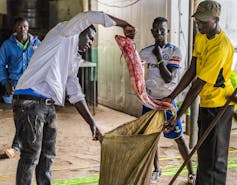
To find out who mattered most in people’s personal networks related to fisheries, respondents were asked to name up to seven people with whom they had discussed their fishing activity within the previous two weeks. What we found was that the largest group within each personal network came from the same occupation, though this was even more the case for fish traders and processors than for boat crew and boat owners.
This was surprising. We’d expected that the networks of fish traders and processors would be more diverse given that they frequently interacted with crew and boat owners to buy fish. Their close relations within the occupational group reflected the high degree of dependence they have on each other. Dependencies included needing to trade onwards, to get access to credit and to get business advice. Around half of their network members lived outside of the landing site, reflecting their wide trading networks.
But we found that most of the network members of boat crew and boat owners stayed at the same landing site. The mobility of fishers might suggest that their networks would be more geographically diverse, but boat crew rely on their local friends when they migrate in search of better fish catches and prices, using their networks to help them move.
Benefiting from ties
So, how do people benefit from these social ties?
For boat crew, financial help and provision of advice were the most common benefits stated. Most advice related to fishing grounds, but also included advice on running businesses and how to get into fisheries. Boat crew frequently rely on each other, for example they may replace a friend who can’t go out to fish or share their portion of the catch with crew members who were not able to go out or caught a poor catch. These reciprocal arrangements provide an important safety net.
Boat owners reported that they benefit from boat crew through the skill, hard work and knowledge the crew members have. They also benefit from ties with other boat owners through providing financial assistance and advice. In terms of their relationships with fish traders and processors, boat owners gain access to credit and secure a market for their catch. Fellow fish traders/processors also benefit significantly from receiving advice and assistance from each other, such as helping secure access to markets and transport fish.
The networks are therefore critical for gaining access to credit and employment, maintaining reliable and skilled labour, and sustaining access to markets. People turn to each other when in need of resources and advice, whether in relation to fisheries, running their business or for personal matters. These networks ensure that fish, income, employment and information flow, at and from the landing sites. They also confirm that there is constant economic and social interaction, with personal and work lives strongly intertwined.
These networks, associated with the provision of advice and credit, could be harnessed to use peer communication in tackling illegal fishing. They could also be harnessed to strengthen the case for, and implementation of, co-management of the lake’s threatened fisheries. The findings confirm that the cohesive nature of fishing communities is encouraging for community-based and collaborative management as community members have shown themselves to be able to work effectively together.

Fiona Nunan receives funding from the Leverhulme Trust and the Ecosystem Services for Poverty Alleviation programme, funded by the UK Natural Environment Research Council, Economic and Social Research Council and the Department for International Development.
: The Conversation – Articles (AFRICA)
Have you tried: Sailing in Africa ?